
Beyond Candlesticks: An Intro to Order Flow Analysis
How order flow provides clues to help you make better bets.

Here's a quick introduction on Order Flow Analysis and how I use it to make more confident trading decisions. I'll cover the benefits as I see them, and how it aligns closely with the reality of how the market operates.
TL;DR
Order flow analysis gives me deeper insights into market behavior than traditional candlestick charts.
Understanding order flow gave me the framework and data-driven insights needed to trade with more confidence.
By understanding the nuances of market transactions, I can find valuable clues to support or challenge my trade ideas.
It's not a one-size-fits-all solution, but it's invaluable for analytical traders like me who understand market mechanics.
See Inside the Bars
"A good tool improves the way you work. A great tool improves the way you think." – Jeff Duntemann
While most traders look at candlestick charts, some of us look a little deeper at the transactions that create the candlesticks. We call that Order Flow Analysis (or OFA).
Order flow analysis involves analyzing the sequence and volume of transactions within the bars. It can transform a simple candlestick chart into a cluster chart, footprint chart, liquidity chart, or a variety of other volume or transaction-based charts. These charts give traders nuanced insight into market behavior, revealing the fine details that candlesticks alone may obscure.
Benefits of Order Flow
"Without data, you're just another person with an opinion." – W. Edwards Deming
For me, OFA allows me to spot clues that either support or challenge my trade ideas, offering a deeper understanding of market movement and buyer/seller behavior.
Enhanced Decision-Making
"Get your facts first, then you can distort them as you please." – Mark Twain
Because order flow charts are derived from real market data, untainted by the algorithmic tricks common with most indicators, OFA provides factual, evidence-based insights without any pre-programmed bias.
Data Beats Emotions
"The goal is to transform data into insight, and insight into action." – Me :)
You might say the information is more "pure," and this purity allows me to trust the information more and make rational trading decisions with conviction. Unlike standard indicators, order flow involves no “hocus-pocus” manipulation of the data shown on screen. It is purely market-generated information.
If you are analytically minded like me, and find yourself lacking structure or sufficient information to make a decision, order flow analysis might provide what you need to pull the trigger on—data-driven insights from market-generated information.
My Secret to Winning Trades
We've all experienced buying at the top or shorting at the bottom, only to end up stuck holding the bag. We believed the breakout or breakdown would start a trend, but it didn't. The way to avoid doing this is by understanding order flow, how other participants are positioning themselves, and aligning with the dominant side.
Here's my big secret to winning trades:
Don't be the one left holding the bag. Aim to position yourself so that other traders come in after you to support your position.
Some Examples & Interpreting Charts
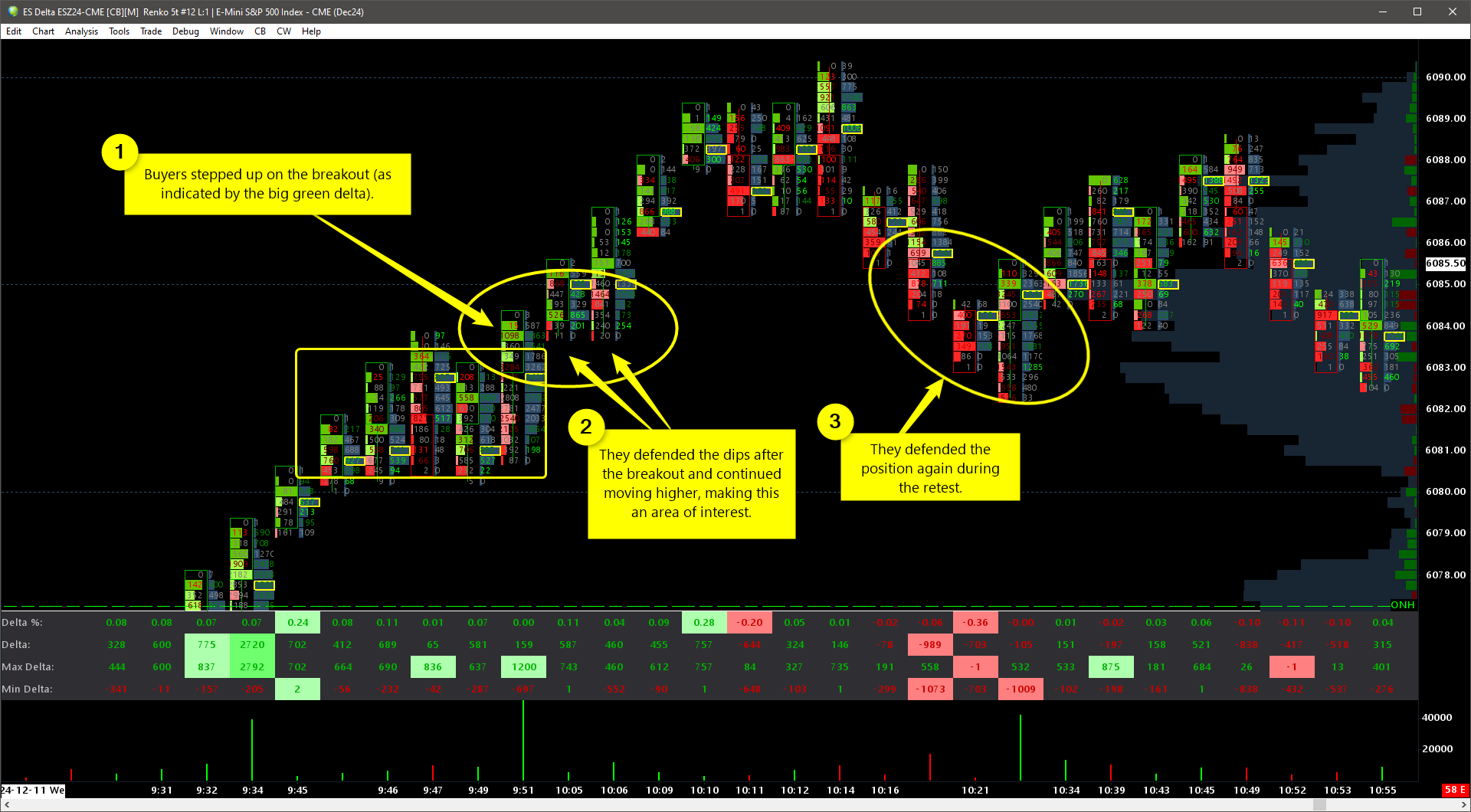
Here's an example of how OFA helps me. The following chart is a 5T Renko chart on #ES_F with a delta profile, volume profile, and footprint overlay. This is a very basic example of reading order flow on a breakout to get long on a retest.
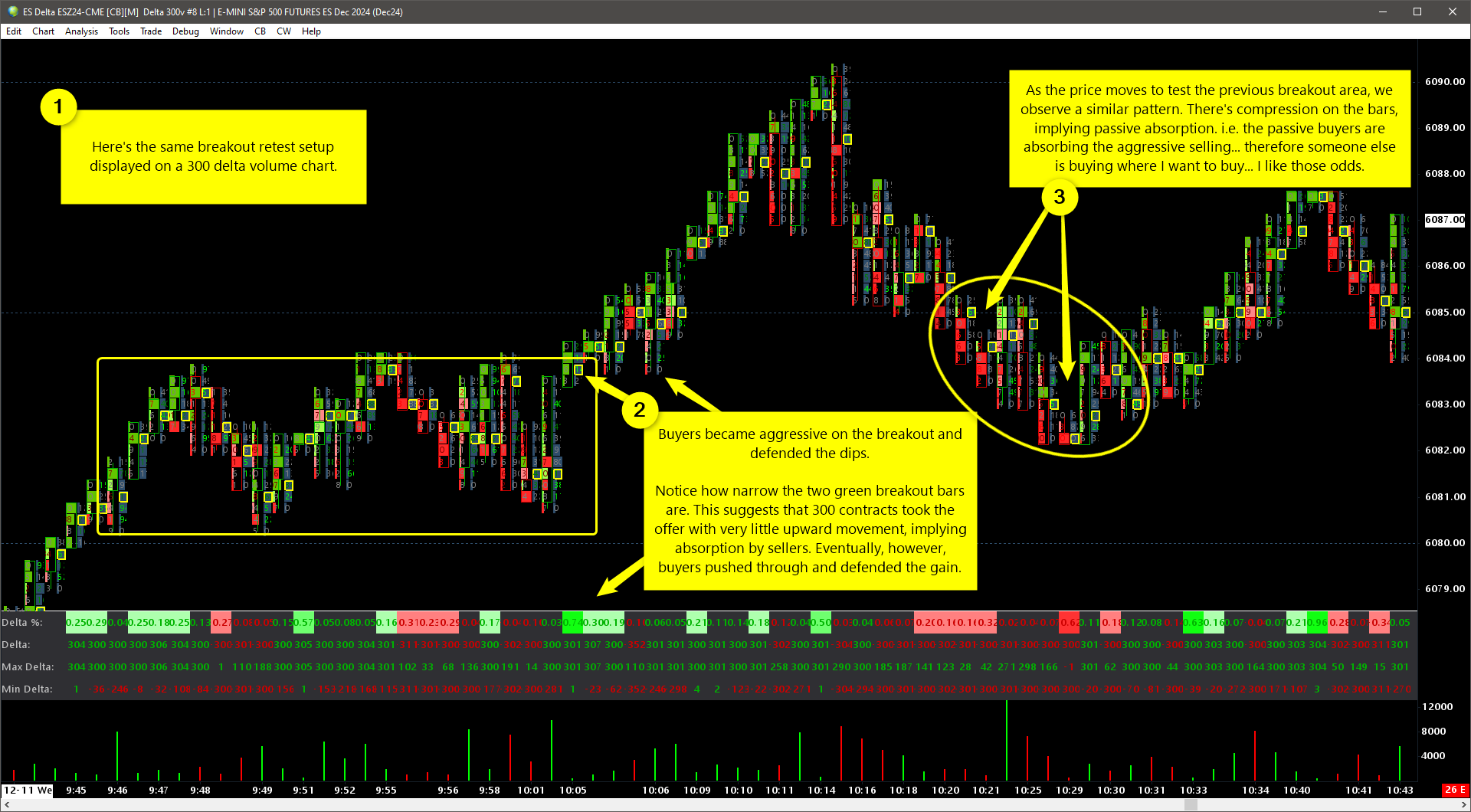
Here's the same setup on a slightly different chart. This time we're using a 300 Delta, which prints a new bar every time 300 contracts are traded on either the bid or the offer. This is great for spotting absorption by big players.
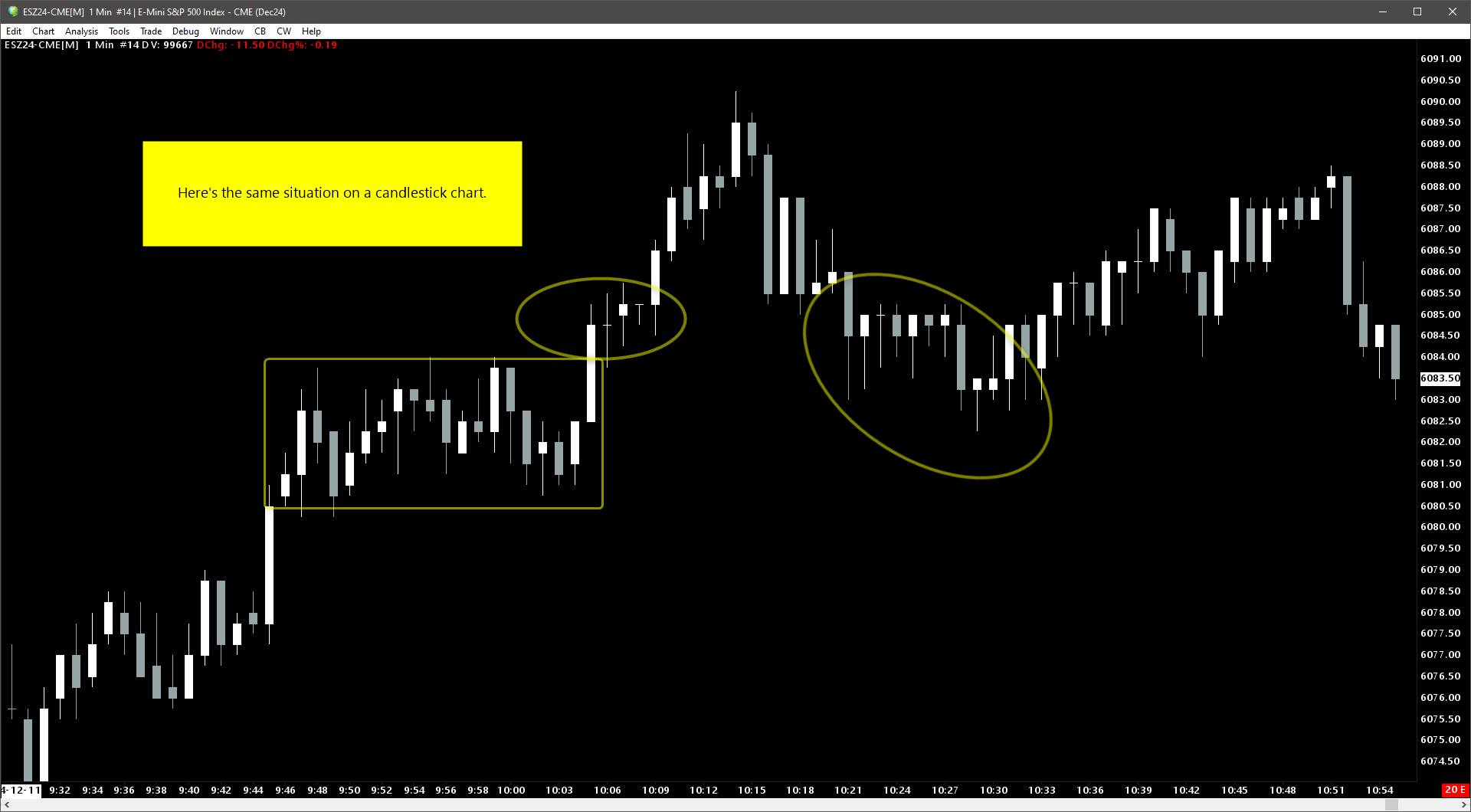
Finally, here's the same situation as you'd see it on a regular candlestick chart, minus the market-generated information.
I can go into a lot more depth, but I think one example is enough to reinforce my point:
"Order flow offers clues to help you make better bets".
Disclaimer
While order flow analysis can enrich your trading strategy by providing a deeper understanding of market transactions, it's not a one-size-fits-all solution. It's an advanced trading method closely aligned with how markets operate, that requires deeper study of market dynamics and context. It might seem complex, particularly for newcomers, but if you are analytically minded like I am, then it may be worthy of your attention.
What’s Next?
In future articles, I’ll explore my playbook setups in more detail and explain the context conditions in which they work best. Since context is the deciding factor that validates a trade idea, I’ll also share my logic and framework for assessing market context. Subscribe to my newsletter and stay tuned for future updates.
Questions?
Leave a comment below if you have questions. I want to know what your current trading approach looks like. There is no right or wrong answer. When it comes to trading, there's something for everyone.